

Talking to Your Catholic Family about Abortion
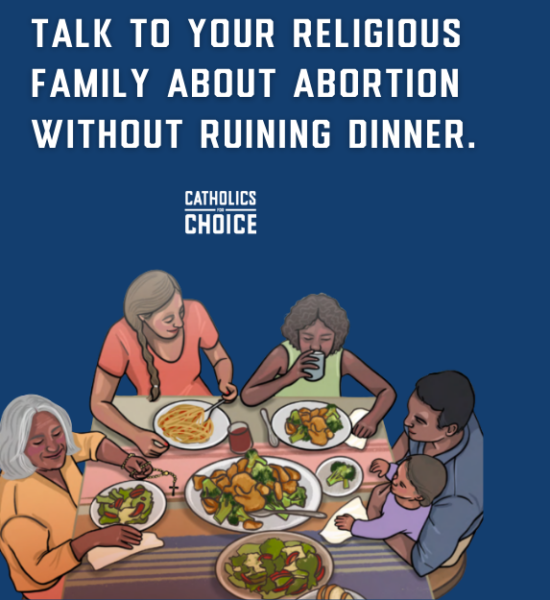
As Catholics for Choice, we get it.
Talking to your Catholic family is hard.
Whether you’re Catholic, raised Catholic, or an ally, the stigma around abortion can make it tough to talk about.
But abortion access is under attack now more than ever.
We have a moral responsibility to break the silence.
ELEMENTS OF A COMPASSIONATE CONVERSATION
- Know your audience: What are your goals? People don’t change their minds overnight. Start small. And remember — even if talking to your uncle at dinner ends in disaster, you never know who might be listening in silence at the table.
- Plan ahead: Speaking of dinner tables, when and where will you start the conversation? The setting should match your goal. If you’re feeling squeamish about opening the floodgates, it can help to write down your first sentence or start by bringing up a current event.
- Listen and repeat: Let the other person know that you are listening rather than just planning what you will say next. Don’t interrupt, and practice active listening like head nods, and other body language. Use, “What I heard you say was X. Is that correct?” to show that you are hearing their perspective.
- Clearly communicate your thoughts: Remember, this is a discussion, not a monologue! So, speak your truth, but don’t monopolize the conversation. Using “I” statements is helpful to share your thoughts, such as “I feel X because Y.” This guide provides short talking points and facts to pepper into your conversation but remember that stories are key to changing hearts and minds.
- Change will not happen overnight: Do not set out to change the minds of your dinner companions right from the start. Having these conversations is ongoing work that allows us to destigmatize abortion and make space for people to grapple with the moral complexity of abortion and Catholicism. There is a lot to be unlearned, and it cannot all be done at once.
Just the Facts
THREE GROUND RULES
- Assume nothing: Pro-choice beliefs don’t fall neatly along party lines, and people who identify as “pro-life” have abortions. Anyone who’s experienced a pregnancy loss has likely gone through an abortion procedure.
- Approach with care and curiosity: Make sure your conversation partners know you’re not in a space of judgment. Pregnancy, childbearing, and miscarriage can be deeply complex and personal topics. If someone is struggling with how they feel about abortion, that’s okay!
- Remember that everyone is the expert on their own story: Facts can be debated, but it’s harder to disagree about personal stories. If someone shares their abortion story, it’s important to honor that truth. Even if the story doesn’t align with your ideas about abortion, faith, or conscience, we hold space for storytelling.
Here are some of the values that Catholics can share — regardless of how they feel about abortion.
We don’t want the government interfering with family decisions. Even if your loved one thinks abortion is morally wrong, banning abortion means the government would decide how many children we can have.
We support religious freedom. In a nation founded on the idea of separation of church and state, the religious beliefs of some shouldn’t overshadow the beliefs of others. That means each Catholic has the right to practice as they see fit — whether they choose natural family planning, contraception, abortion care, or none of the above.
We believe children are a blessing. According to the Centers for Disease Control and Prevention, 60% of people who have abortions are already parents. Abortion, much like birth control, can be an important part of building a family.
We trust that everyone can make moral decisions about their lives. God gave us free will for a reason. Through faith, we can use our consciences to make medical decisions.
If you agree with any of these statements, then you believe in a pro-choice value.
Whenever your conversation with your family gets tough, return to your shared values. Show your loved ones you are pro-choice because of your religious beliefs, not in spite of them.
THREE PRINCIPLES OF PRO-CHOICE CATHOLICISM
- Conscience
- Catholic doctrine has long taught that each person’s individual conscience has the final say in all moral decision-making.
- As the Catechism of the Catholic Church (para. 1778) states, “In all [one] says and does, [one] is obliged to follow faithfully what [one] knows to be just and right.”
- We trust that the people who choose abortion are following their faithfully formed consciences, and we support them in their decision.
- Social Justice
- Abortion bans and restrictions disproportionately harm the poor, the vulnerable, and the marginalized — the very people our faith calls us to prioritize.
- We believe that to deny someone reproductive care is to disregard their basic human rights.
- Religious Freedom
- As Catholics, we believe that one religious group’s beliefs should never be codified into law.
- Religious freedom guarantees the right to practice one’s religion and to be free from the religious beliefs of others.
PRO-CHOICE CATHOLIC THEOLOGY
Here are a few important ideas from Catholic theology and church history that support our perspective.
- Abortion is never banned, shamed, or discouraged in the Bible.
- The total prohibition of abortion only became the law of the Catholic church in 1917.
- The church has never formally excommunicated someone for having an abortion nor has it formally excommunicated anyone for supporting abortion rights.
- The Catholic church’s teaching on abortion has not been declared infallible, and it has changed over time.
- St. Augustine and St. Thomas Aquinas, two of our church’s most influential theologians, taught that a fetus didn’t have a soul until later in pregnancy.
- In 2016, Pope Francis decreed that any priest could welcome people who’ve had abortions into the church if they make a confession.