Toggle Banner
Mifepristone is under attack. Join our campaign to help defend medication abortion!
LEARN MORE

Catholic Campuses 4 Contraception
Comprehensive healthcare, like contraception, is an essential part of caring for the whole person. But most Catholic institutions fail to recognize this truth. That’s why we’re launching Catholic Campuses 4 Contraception, emboldening students, alumni, and community members to take action.

Introducing Catholic Campuses 4 Contraception

A campaign for students, alumnus, and community members to advocate for contraception on Catholic campuses. Read our letter to Jesuit University and College Presidents below!

SIGN HERE AND READ THE FULL LETTER BELOW
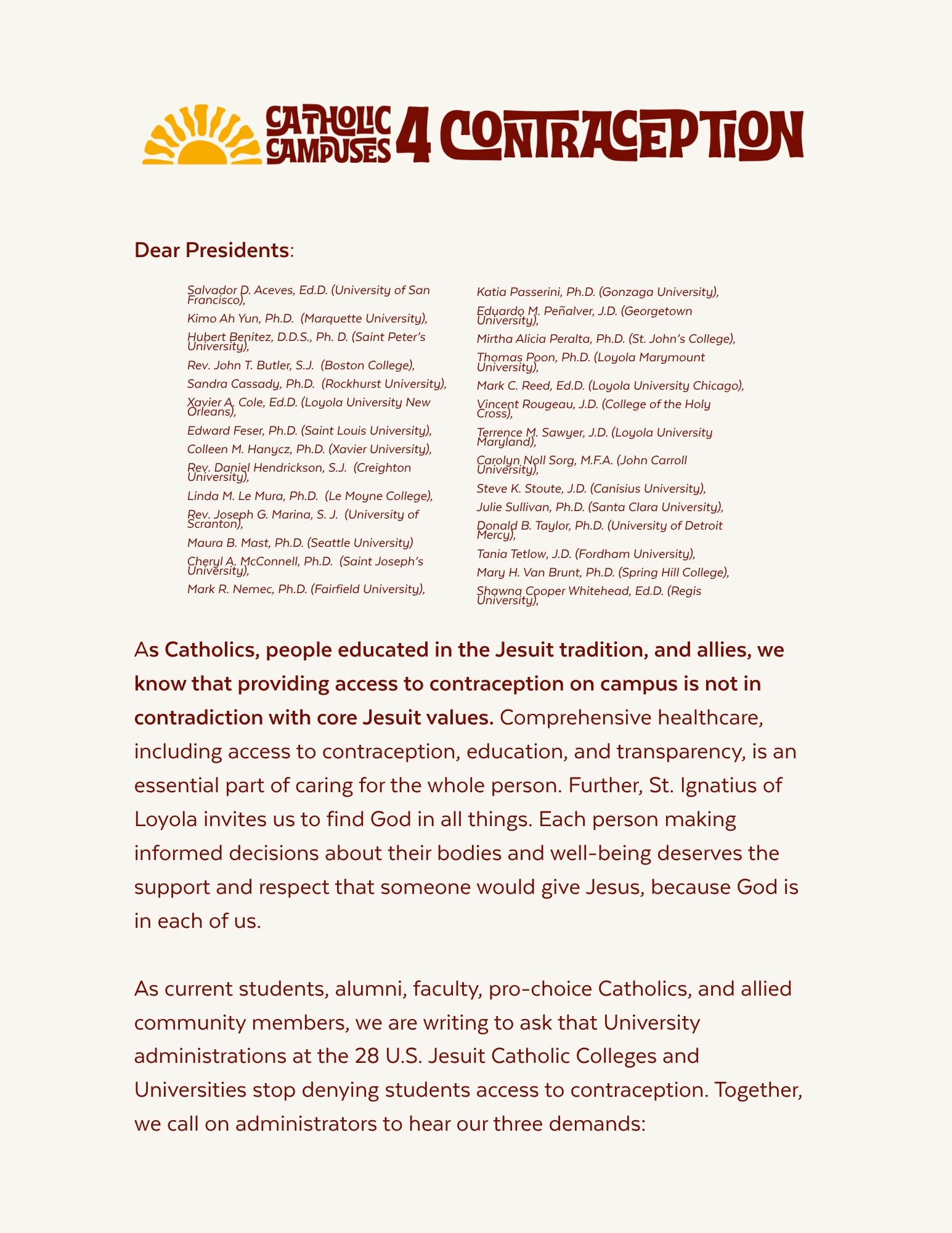
Dear Presidents, As Catholics, people educated in the Jesuit tradition, and allies, we know that providing access to contraception on campus is not in contradiction with core Jesuit values. Comprehensive healthcare, including access to contraception, education, and transparency, is an essential part of caring for the whole person. Further, St. Ignatius of Loyola invites us to find God in all things. Each person making informed decisions about their bodies and well-being deserves the support and respect that someone would give Jesus, because God is in each of us. As current students, alumni, faculty, pro-choice Catholics, and allied community members, we are writing to ask that University administrations at the 28 U.S. Jesuit Catholic Colleges and Universities stop denying students access to contraception. Together, we call on administrators to hear our three demands: TRANSPARENCY: Be transparent online about which sexual health services you offer, provide external resources for services you do not offer, and share how relevant policy changes may impact students. Jesuit Universities welcome and recruit students and faculty of all and no faiths. For their decisions to be fully informed, current and prospective students and staff must be made aware of how reproductive health restrictions might impact them. In cases where services will not be provided on campus, the university is responsible for providing streamlined connections to competent external providers. EDUCATION: Permit students, staff, and community members to speak publicly about gender and reproductive justice in all campus locations. Campuses are places where students come to learn and grow from faculty and one another. Prohibiting education and speech about reproductive justice on campus directly contradicts the university's central purpose. ACCESS: Allow students, faculty, and staff to distribute free and accessible contraception for the purposes of preventing pregnancy. Access to sexual and reproductive healthcare is a basic right of students. Most colleges and universities in the United States provide this care to their students. Not only does providing contraception on campus allow students to make their own reproductive decisions, but it also supports students in preventing STIs and is critical care for survivors of sexual violence. Time after time, it has been made clear that the health and well-being of students at Catholic colleges suffer because of a lack of access to basic care. A Georgetown student had to have an ovary removed because they couldn’t afford the out-of-pocket costs of her birth control. A Fordham student lost their campus housing and scholarship when they were unable to afford contraception and became pregnant. A 2016 study found that Marquette University was the least sexually healthy campus in the U.S. Denial of contraception is a violation of the Catholic value of religious freedom. Restricting reproductive freedom not only runs afoul of the diversity of religious traditions of students and staff, but also the religious freedom of the pro-choice Catholic majority who disagree with church teaching. Freedom of religion does not give Catholic colleges and universities the license to strip students of the fullness of their religious identities. The Catholic majority agrees. 99% of Catholic women have used birth control. Additionally, 84% of Catholics think the church should allow people to use birth control, and only 8% of Catholics believe that using birth control is morally wrong. Student referendums have also shown it is overwhelmingly popular on campus. Policies based on a narrowly held belief that endanger the health of students are not what Catholics want and do not reflect Catholic values. Catholic colleges must stop allowing their denial of contraception to be what defines them and their vision of the faith. Catholicism is an incredibly rich tradition, as is the Jesuit tradition of social justice. Catholic institutions of higher education must live into the diversity of the Catholic faith and honor the Catholic principles of social justice and the dignity of all people by making contraception accessible. We ask you to live into the Jesuit value of discernment as you read this. Thank you for hearing our demands, and we look forward to seeing you act on these requests. Signed,

St. Ignatius of Loyola, the founder of the Jesuits, reminds us of his call to find God in all things — including contraception.

God is with the advocates who fought for access to contraception. God is with those who use contraception to take control over their lives, bodies, and futures. And God is with those who are denied access to the contraceptive care they need.

Comprehensive healthcare, including access to contraception, education, and transparency, is an essential part of caring for the whole person. Contraception isn’t a sin; it is a lifeline, and it ought to be accessible anytime, anywhere, and for any reason.

However, many Jesuit Catholic universities — which are supposed to be rooted in Catholic social teaching — fail to hear this call. Instead, they refuse to provide students with contraception and do so by weaponizing the faith against the very people whom they are meant to support and embolden to succeed.

What they aren’t acknowledging is the violation of Jesuit values by not allowing students to care for their whole selves.